
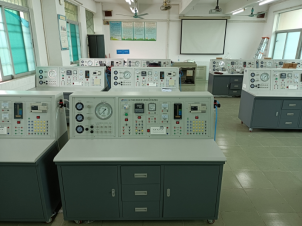
描述
Automated Instrument Panel
I. Overview
The design must fully comply with the requirements of the China Classification Society's "Code for the Classification and Construction of Steel Seagoing Ships." It shall incorporate advancements in modern ship automation and establish an automation instrumentation work platform based on the specialized skill requirements for automated vessels. This platform shall be designed for ship electrical and automation instrumentation control systems, ensuring consistency with modern ship automation instrumentation. It must meet the comprehensive training and assessment requirements for crew members in ship automation instrumentation.
The integrated test bench for ship automation instruments must achieve the following primary functions:
(1) Differential pressure transmitters can perform pneumatic and electrical connection operations, operate three-way valve assemblies, adjust and migrate zero points and ranges, and configure fault settings for air leaks, air blockages, cable open circuits, or short circuits.
(2) All temperature sensors feature encapsulated enclosures and are heated to a fixed temperature by a heating source. The temperature sensor outputs a variable signal to the temperature signal conditioning unit, which converts it into a 4–20 mA output signal. The signal conditioning unit and the heating temperature automatic control unit can be integrated into a single assembly. The system supports simulated settings for sensor loop open circuits, short circuits, and insulation faults.
(3) The regulator module requires the aforementioned differential pressure transmitter and temperature sensor for signal detection. Input signals, output signals, alarm signals, and power connections can be configured according to control requirements. One output provides heating contacts to a 220V heating circuit, while another outputs 4–20mA to the temperature control valve. The digital intelligent regulator features built-in setpoint configuration, parameter settings, and relevant parameter displays. By comparing detected signals with setpoints and analyzing the regulation patterns, one can observe and evaluate the regulator's output results. This enables assessment of the regulation effectiveness and calculation of the regulation parameters. Sensor and heater faults can be simulated to analyze fault causes and determine appropriate handling methods.
(4) The display instrument module must simulate sensor fault indications to facilitate observation of actual parameters and displayed values, thereby aiding fault analysis and diagnosis. It must also allow for necessary display function selection settings.
▲Provide clear physical images of the products being tendered, along with detailed design drawings to support them;
▲For unfinished, non-customized products, provide on-site photos of completed projects along with a copy of the contract (original available for inspection on-site).


 Chinese
  English
  Korean
  Japanese
  Thai
Thai  Arabic
  Spanish
  Russian
  Vietnamese
  Indonesian
评价
目前还没有评价