
描述
Star Card
Legal Basis: Regulations on the Administration of Seafarer Training of the People's Republic of China (Order No. 5 of the Ministry of Transport, 2019)
Product Category: Captain, Chief Officer, Third Officer Training
Product Name: Suxing Card
Functional Requirements: Meet the requirements of the training syllabus.
Specified quantity: 20 sets
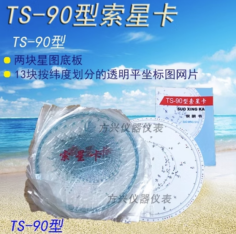
TS-90 Satellite Card
1. Structure of the Star Finder
Star Chart: Consisting of two star chart base plates and several transparent horizontal coordinate grid overlays divided by latitude.
(1) Star Chart Motherboard
Projection Method: The celestial map plate is a projection of the celestial sphere, created using the principle of polar equidistant projection. One plate centers on the North Celestial Pole, while the other centers on the South Celestial Pole.
Content: Features aviation stars (first-magnitude, second-magnitude, and select third-magnitude stars), the celestial equator, the ecliptic, and the local hour angle (or celestial right ascension) of the vernal equinox, along with the date of the mean solar time.
(2) Transparent horizontal coordinate grid
Each set comprises 13 sheets, each depicting a series of contour lines for elevation and azimuth at intervals of 0°, 5°, 10°, ... 60° latitude. Each transparent horizontal coordinate grid is dual-purpose for both northern and southern hemisphere surveyors, marked with N and S respectively.
Content:
① The central “+” indicates the observer's zenith, with radial curves representing celestial azimuth circles marked with directional readings at their ends. Inner numbers denote the celestial azimuth as seen by observers in northern latitudes; outer numbers indicate the celestial azimuth as seen by observers in southern latitudes.
② The horizontal closed circular curve represents the celestial altitude parallel circle;
③ The chart features rectangular notches for marking planetary positions, with latitude scales within ±30° north and south on both sides. On the transparent horizontal coordinate grid, two parallel lines indicating solar altitudes of -6° and -12° are marked on either side.
2. Using a star chart to select and identify stars
Using a star chart to select and identify stars typically involves three steps:
(1) Plot the observable planetary positions on the star chart baseplate;
⑵Determine the observable starry sky based on the observer's latitude;
⑶ Star selection and identification based on the observable night sky.



 Chinese
  English
  Korean
  Japanese
  Thai
Thai  Arabic
  Spanish
  Russian
  Vietnamese
  Indonesian
评价
目前还没有评价