

Ship Power Station Automation Core Practical Guide
In-depth analysis of automatic parallelism, intelligent load distribution and emergency recovery from ship-wide power loss
In modern automated ships, the power management system (PMS) is not only the hub for maintaining grid stability, but also a key point in the fitness assessment of electrical and electronic operators (ETOs). In this paper, we will summarize the core knowledge points from basic functions to emergency response.
I. Seven basic functions of ship power station automation
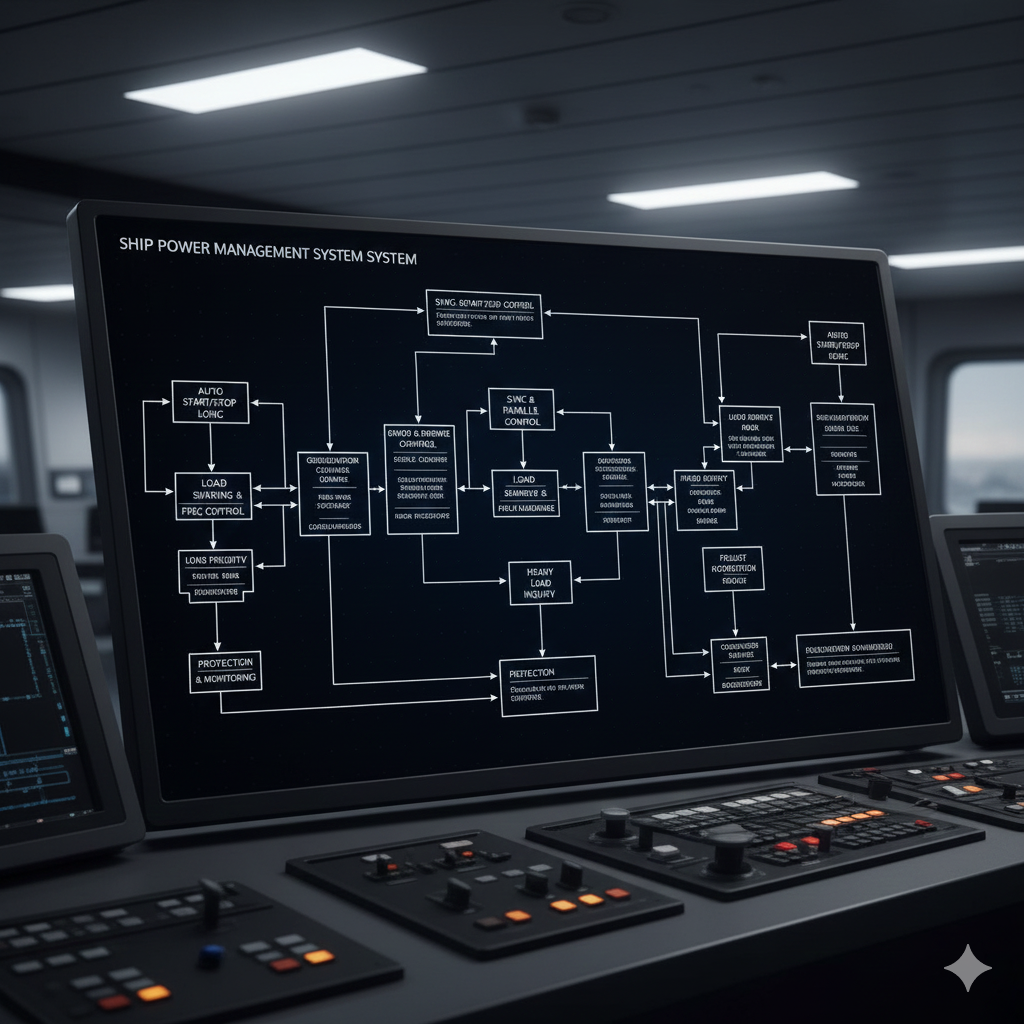
The core task of the automatic power station is to realize the optimized management of the unit under unattended operation. Its basic functions include:
- Automatic start-stop: Automatically manages units based on grid load levels (e.g., heavy load 80% increase, 20% decrease).
- Quasi-synchronized parallel cars: Capture optimal instantaneous closing with consistent voltage, frequency and phase.
- Automatic load distribution: Ensure that parallel units carry active and reactive power in proportion to their rated capacity.
- Reload the query: Power margin prediction for high power loads (sideloaders, cargo lifters).
- Fault integrated protection: Realize automatic replenishment of oil slipping, cooling, overspeed and short-circuit tripping.
 II. Automatic start-up of standby units: triggering and determination
When any of the following conditions are met, the grid will issue an incremental machine command:
Core Trigger Events:
- Grid load exceeds the single 80% (Heavy Load alarm).
- Frequency or voltage deviation exceeds ±5% for 5 seconds.
- Secondary alarms (low sliding oil, high cooling temperatures, etc.) are present in the on-net units.
- The power of a large load about to be committed is detected to exceed the remaining capacity.
Ready“ self-test criteria for standby units
| checklist | Qualifying standards |
|---|---|
| Gas/Energy | Starting air pressure normal, fuel handle in run position |
| Mode Selection | The control panel is switched to the REMOTE remote control and there is no “lock” signal. |
| ancillary facilities | The coiler is out and the pre-lubrication pump is functioning properly |
| electrical state | ACB status OPEN, no speed feedback signal |
III. Process Flow of Unwinding and Load Shifting
Auto-disconnect is not a direct trip, but a smooth “load unloading” process:
- Trigger command: The load drops to the preset lower limit (20% rating) and meets the delay.
- Load Relay: To be unloaded machine gradually decelerated, the operating machine synchronized growth rate, power pointer intersection transfer occurs.
- Soft Split: When the load drops to near zero, the ACB automatically jumps off, realizing shock-free power failure.
- Cooling down: 1-minute delay after tripping (no-load cooling) to protect turbocharger and exhaust valve.
IV. Emergency Column: Blackout Recovery
Blackout is the most extreme test of a PMS system with the following recovery logic:
- Loss of power discrimination: Sink voltage below 15% rating.
- The first robocombination: The unit with the highest priority starts itself and closes directly on the “dead sink”.
- Graded load recasts: Key pumping units such as main engine oil pumps and cooling pumps are combined first, followed by auxiliary living facilities.
✅ ETO Practical Inspection Points
- Check the automatic parallel closing advance angle, ideally the closing action should be initiated at the 11 o'clock position.
- Verify that the grid frequency does not fluctuate more than 0.5 Hz during load transfer.
- Verify that the system can successfully “block” a de-listing command when there is a sudden increase in load in the middle of de-listing.
- Check that the synchronization meter has automatically cut off the power supply at the end of the parallel.








 Chinese
  English
  Korean
  Japanese
  Thai
Thai  Arabic
  Spanish
  Russian
  Vietnamese
  Indonesian

