

Manual of Common Faults and Repair Practices of Relays
I. Basic Concepts of Thermal Relays
⚠️ Core Points: Thermal relays are used for overload and phase loss protection of motors and cannot be used for short circuit protection.
1. Components and principles of thermal relays
When the motor is running normally, the contacts do not operate. When the motor is overloaded, the heating element heats up more than the rated value, which increases the bimetal's deformation and bending degree, and pushes the contacts to break through the guide plate, and the control circuit is cut off and the AC contactor releases by cutting off the power to protect the motor.
Thermal relays consist of two parts: the thermal element and the contacts. When used, the thermal element is connected in series in the main circuit and the normally closed contacts are connected in series in the control circuit. At least two heating elements are used.
2. Symbols for thermal relays
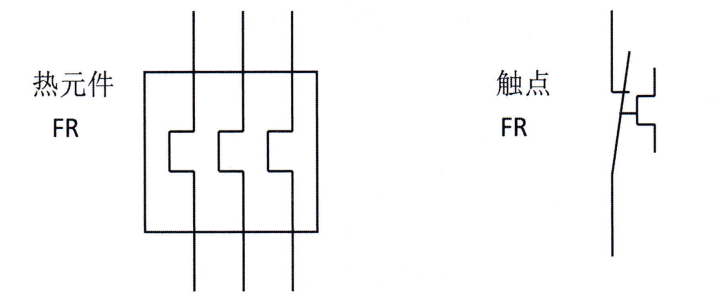
Figure 19-6 Symbols for Thermal Relays
II. Adjustment and reset of thermal relays
1. Adjustment of thermal relays
Select the thermal relay according to the rated current of the motor, and the rated current of the thermal element is 1.1 to 1.25 times the rated current of the motor. The setting value of the thermal relay is the rated current of the motor. If the rated current of the motor is 18 A, turn the adjusting knob so that 1 8 and A can be aligned with the mark, as shown in Figure 19-7.
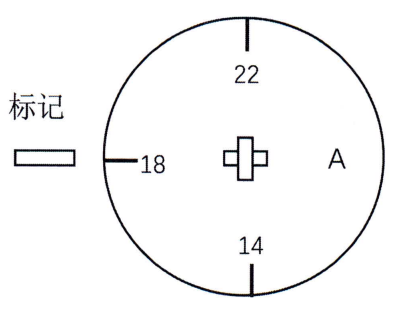
Figure 19-7 Adjustment Schematic for Thermal Relay
2. Resetting of thermal relays
There are two ways to reset the thermal relay after it has been actuated (human selectable): the contacts are reset automatically; the contacts must be reset by pressing the reset button.
Example:The Model JR16B Thermal Relay can be selected for either automatic reset or manual reset. Its original set state is auto reset, to manually reset, the selector screw can be screwed out from the round hole next to it.
Third, the common faults of thermal relays and processing methods
| fault phenomenon | Reason for failure | Treatment |
|---|---|---|
| Inactivity or slowness of movement | The value of the setting current is too large, the thermal element is damaged or desoldered, the action mechanism is jammed, the bimetal plate is aged or deformed, and so on. | Reasonable adjustment of the setting current value, replacement of damaged or desoldered thermal components, elimination of action mechanism jamming factors, replacement of aging or deformation of the bimetallic sheet. |
| malfunction | The set current value is too small, the ambient temperature is too high, the connecting wires are too thin, the starting time of the motor is too long, and the internal mechanism is loose. | Reasonably adjust the setting current value, improve the ambient temperature, replace the connecting wires with suitable cross-sectional area, select the suitable thermal relay according to the motor condition, and fix the internal loose parts. |
| Unstable movements | Loose internal mechanism, bimetal bending, power supply voltage fluctuation, loose wiring screws, etc. | Reinforce the internal mechanism, correct or replace the bimetal, stabilize the supply voltage, and tighten the wiring screws. |
| Main or control circuits not working | Burnt thermal elements, untightened wiring screws, burnt contacts or loss of contact elasticity, improperly positioned adjustment screws, etc. | Replace burnt thermal element, tighten wiring screws, repair or replace contacts and contacts, adjust screws to proper position. |
Common faults and repairs of inverse power relays
(i) Functions of inverse power relays
Reverse power relay is one of the important protection components in ship power station, the main function is to sense the direction of current and automatically disconnect the alternator from the grid when reverse power occurs, so as to protect the safe operation of generator set and power grid. For example, NGJ-1 type reverse power relay is the latest generation of products in China, with beautiful appearance, complete functions, convenient adjustment, self-test function, light weight, small volume, only one-third of similar products in China, stable and reliable quality.
(ii) Technical performance of inverse power relays
(2) Inverse power relay power supply: 100 V (or 400 V), 50/60 Hz, A and C phases, power consumption less than 2 V-A.
(3) When the inverse power of the parallel operation unit reaches 3%~15% of the rated frequency (continuously adjustable) with a delay of 3~10 s (continuously adjustable), the inverse power relay operates (a group of passive normally open becomes closed).
(4) Environmental conditions: ambient temperature of 0~55℃, relative humidity of 95%, shock and vibration, oil mist and salt spray during ship navigation.
(iii) Common failures of inverse power relays and how to deal with them
Cause: Damaged or aged internal components.
Treatment: Check the internal components and replace damaged or aging components in a timely manner.
Cause: Loose, worn, fused or poor contact.
TREATMENT: Clean up oxidized layer, adjust pressure, and replace if necessary.
Cause: Broken wire, short circuit or damaged insulation.
Treatment: Check connectivity and insulation, repair or replace.
Cause: Loose riveting and poor bonding strength.
Treatment: Check the tooling and re-rivet.
Cause: Poor contact of iron core, foreign matter or oil contamination.
TREATMENT: Remove foreign matter or oil and ensure flat contact.
Causes: bent pins, glass insulators falling out of place and cracking.
Treatment: Handle gently and replace damaged parts.
Cause: Loose connection, electromagnetic interference or aging of relay.
Treatment: Reinforce connections and keep away from sources of interference.
V. Common faults and repair of time relays
1. Function of the time relay:An electrical device that delays response for a period of time after receiving an input signal.
2. Classification:According to the delay mode can be divided into two categories: power-on time-delay type and power-off time-delay type.
When the coil is energized the contacts are delayed for a period of time before they actuate. When the coil is de-energized, the contacts reset immediately. The symbols are shown in Figure 19-8.
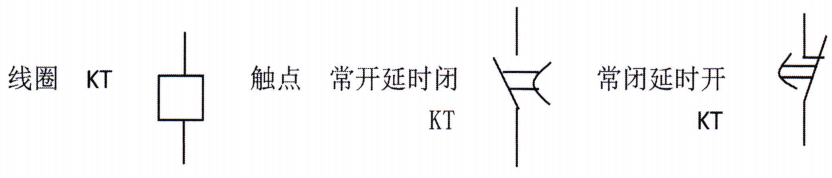
Figure 19-8 Energized Delay Type Symbol
The contacts act immediately after the coil is energized and reset after a delayed period of time after the coil is de-energized. The symbols are shown in Figure 19-9.
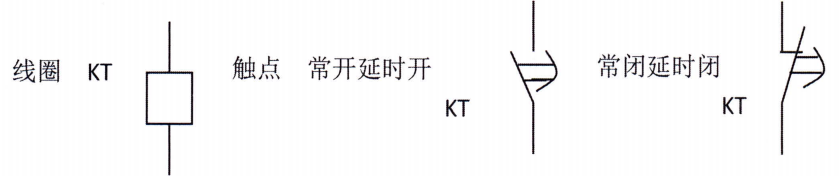
Figure 19-9 Power failure delay type symbol
3. Common failures of time relays and how to deal with them
(1) Inaccurate delay time:
Causes: Poor sealing or leakage of the air bag, obstruction of the airway, damage to the non-magnetic gasket, malfunction of the clock mechanism, change in ambient temperature, etc.
Treatment: Check the sealing, replace the airbag or clean the airway; replace the damaged parts; troubleshoot the problem with several operations; adjust the setting value.
(2) Power failure:
Causes: unstable voltage, short circuit or disconnection of the line, poor contact of the plug and socket.
Treatment: Use a regulated power supply; repair wiring; replace poor contact components.
(3) Contact failure:
Cause: Insufficient capacity/pressure, surface oxidation. Treatment: Clean oxidized layer (oil polish file/petrol); replace relay with higher capacity; adjust spring pressure.
(4) Failure of the electromagnetic system:
Cause: Coil insulation damage, short circuit grounding, core failure.
TREATMENT: Check insulation and connections; replace damaged coil; smooth core contact surfaces.
(5) Does not work when energized:
Cause: Poor power contact, voltage inconsistency, damaged internal electronic components. Treatment: Ensure good contact; check voltage; replace damaged components.
(6) Abnormal sounds:
Cause: Damaged mechanical structure, overheating of electronic components. Treatment: Replace mechanical parts; ensure good heat dissipation.
(7) The display panel is damaged:
Cause: Moisture, damaged electronic components. Treatment: Keep dry; replace damaged components.









 Chinese
  English
  Korean
  Japanese
  Thai
Thai  Arabic
  Spanish
  Russian
  Vietnamese
  Indonesian

