

Practical Application of Clamp-On Ammeters
I. Basic Concepts of Clamp-On Ammeters
1. Purpose
Clamp-on ammeters, as shown in Figure 13-18, can measure alternating current without interrupting the circuit. They are commonly used to measure the starting and operating currents of three-phase asynchronous motors, check whether the three-phase currents are balanced, and determine if the motor is operating under overload conditions. Most modern clamp-on ammeters are integrated into multimeter units, capable of measuring not only alternating current but also other electrical quantities.
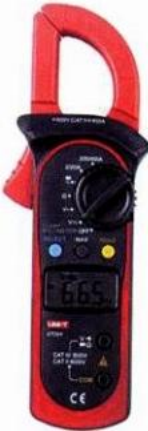
Figure 13-18 Clamp-On Ammeter
2. Composition
A clamp-on ammeter is essentially composed of an iron-core, openable current transformer and a magnetoelectric ammeter. The range selector switch and shunt resistor are used to change the measurement range.
3. Measurement Principle
The principle of measuring current with a clamp-on ammeter is shown in Figure 13-19. When current I_p flows through the conductor being measured, a current I_c is induced in the secondary winding. According to the transformer principle, I_c = I_p / N, where N represents the number of turns in the secondary winding, typically ranging from several dozen to several hundred turns or more. This transforms the high current in the primary winding into a low current in the secondary winding. After rectification by a diode to convert alternating current to direct current flowing through the meter, the magnitude of the primary current can be detected.
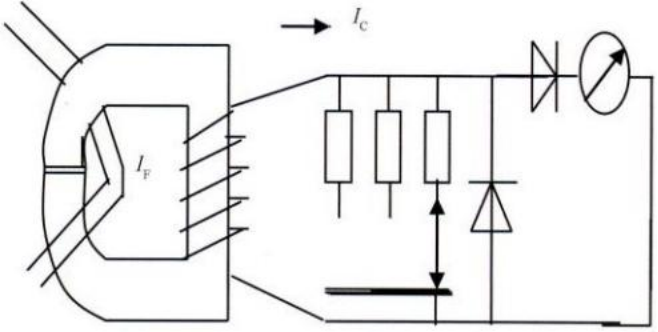
Figure 13-19: Schematic Diagram of a Clamp-On Ammeter
II. Usage Methods and Precautions for Clamp-On Ammeters
1. How to Use
- (1) Zero adjustment:Before use, check whether the pointer is positioned at zero. If not, adjust the mechanical zero adjuster on the dial cover to perform zero calibration.
- (2) Select Range:Select the appropriate range based on the magnitude of the current being measured. When the magnitude of the current is unknown, start with the highest range and then adjust the range based on the measurement results.
- (3) Place the wire:Place the current-carrying conductor to be tested at the center of the iron core to measure the current value.
- (4) Techniques for Measuring Small Currents:If the pointer deflection remains small when using the minimum range, you may wrap the wire several times for measurement when conditions permit. In this case:
Actual current measurement = reading / number of turns. - (5) Storage Guidelines:After measurement, set the selector switch to the maximum range position (current range) or the “OFF” position.
2. Precautions
- 🔴
(1) Jaw cleaning:Keep the jaws clean and tightly closed; squeeze them firmly by hand if necessary. - 🔴
(2) Zero Adjustment and Positioning:Before use, ensure the meter is zeroed. Place the meter flat and away from strong magnetic fields. Position the current-carrying conductor vertically at the center of the iron core. - 🔴
(3) Range Principle:When the magnitude of the current being measured is unknown, start with the maximum range measurement. - 🔴
(4) Transformation Prohibition:Do not change the range during measurement.












 Chinese
 English
 Korean
 Japanese
 Thai
Thai Arabic
 Spanish
 Russian
 Vietnamese
 Indonesian

