

Fundamentals of Electrical Practice: Identification and Measurement of Resistors
Fundamental Skills Training in Marine Electronics and Electrical Systems
I. Basic Concepts of Resistance
Resistance (R) is a physical quantity that represents the degree to which a conductor impedes the flow of electric current. The greater the resistance of a conductor, the greater its impedance to current flow. Different conductors typically exhibit different resistances, as resistance is an inherent property of the conductor itself. The unit of resistance is the ohm, abbreviated as Ω.

Figure 12-1: Resistor Shapes
II. Steps for Measuring Resistance (Analog Multimeter)
1
Select magnification:Select a resistance to block any multiplier. Standard multimeter ranges include R×1, R×10, R×100, R×1k, and R×10k.
Select magnification:Select a resistance to block any multiplier. Standard multimeter ranges include R×1, R×10, R×100, R×1k, and R×10k.
2
Zeroing by Ohm's Law:Short-circuit the red and black test leads, then adjust the ohm-scale zero knob until the pointer indicates zero on the ohm scale.
Zeroing by Ohm's Law:Short-circuit the red and black test leads, then adjust the ohm-scale zero knob until the pointer indicates zero on the ohm scale.
3
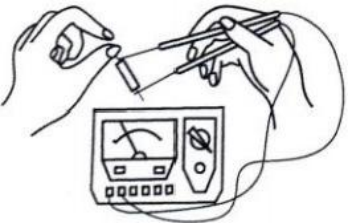
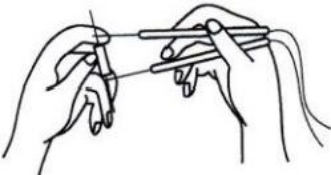
Access Measurement:Connect the resistor under test to the red and black test leads to measure its resistance value. Adjust the multiplier based on the meter needle deflection to keep the needle near the center of the dial.After changing the magnification, you must reset the zero.
Access Measurement:Connect the resistor under test to the red and black test leads to measure its resistance value. Adjust the multiplier based on the meter needle deflection to keep the needle near the center of the dial.After changing the magnification, you must reset the zero.
4
Reading Calculation:Resistance readings are generally expressed with two significant figures, read from right to left.
Actual resistance measurement = Reading × Multiplier。
Reading Calculation:Resistance readings are generally expressed with two significant figures, read from right to left.
Actual resistance measurement = Reading × Multiplier。
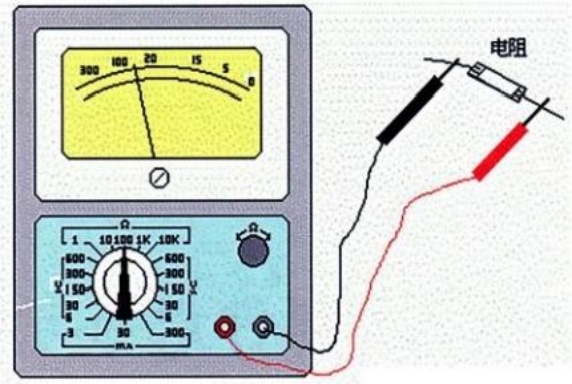
12-2 Multimeter Resistance Measurement Diagram












 Chinese
  English
  Korean
  Japanese
  Thai
Thai  Arabic
  Spanish
  Russian
  Vietnamese
  Indonesian

