
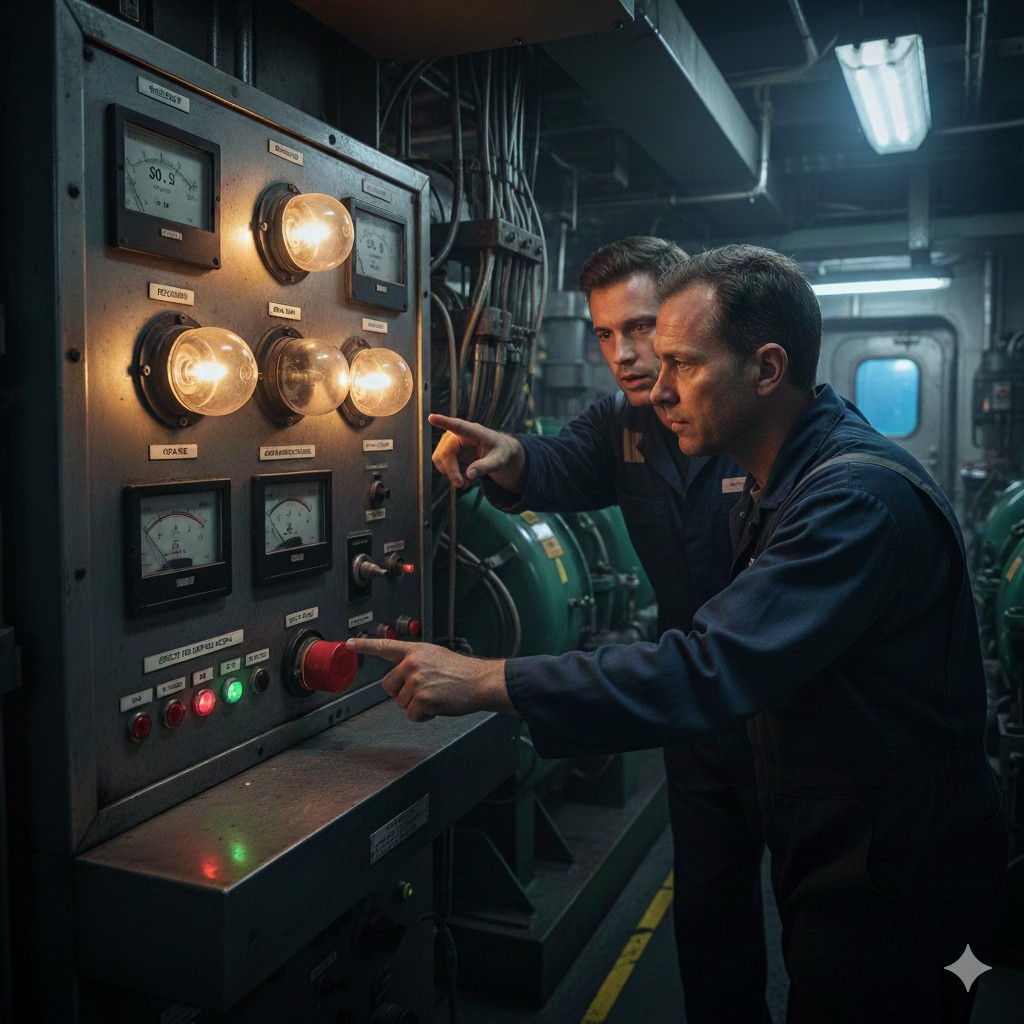
Light and dark method or light rotation method Synchronized parallelism, load transfer and distribution
一 Synchronous generator parallelism
1. Grid status check before connection (assuming that generator No. 1 is running on the grid at this time, and generators No. 2 and 3 are on standby)
(1) The operating mode of the power station is in manual mode, i.e. the mode selector switch is turned to the “MANU” position.
(2) Determine that the voltage and frequency of generator No. 1 are normal. If the frequency and voltage deviate, adjust accordingly.
(3) Observe the power of the generator running on the grid, if it is greater than 80% of its stand-alone power, the standby unit must be started.
2.备Startup of the unit
(1) Combine the utilization and electromechanical status of generators No. 2 and No. 3 and select a generator as a standby unit (assuming that generator No. 2 is selected in this case).
(2) Check that the No. 2 generator has the following starting conditions: cooling water, lubricating oil, fuel oil, and starting air supply. Verify that the “LOCAL/REMOTE” selector switch on the side control panel is in the “REMOTE” position. Verify that the unit's “READY FOR START” light on the main switchboard remains on.
(3) When manual parallelization is required, press the “ENGINE START” button of generator No. 2, start the standby unit, and wait for the unit to accelerate to a speed close to the rated speed. Observe whether the voltage and frequency of the generator to be merged are normal. The voltage will generally meet the requirements for parallelization and does not need to be adjusted because it is guaranteed by the automatic voltage regulator (AVR). The speed of the generator to be connected can be adjusted manually (by pulling the “acceleration/deceleration” switch) so that its frequency is the same as the grid frequency or slightly higher.
3.Merging (using the light rotation method)
(1) Turn on the synchronization indicator to select the generator to be merged, and detect the size, direction and phase difference of the frequency difference between the grid and the generator to be merged through the lights. The direction of rotation of the three lights under the synchronization table depends on the direction of the frequency difference, clockwise means that the frequency of the generator to be connected is higher than the grid frequency. The length of the period of light and dark change (the period of rotation) indicates the size of the frequency difference, and the rotation period is inversely proportional to the frequency difference, such as when the required frequency difference is equal to 0.25 Hz, the rotation period should be 4 s. The phase difference is constantly changing, and the direction of rotation of the three lights under the synchronization table depends on the frequency difference. Phase difference is constantly changing, corresponding to the phase lamp (the top one) indicates the instantaneous phase difference, such as the darkest moment (the center of the dark zone) represents the phase difference of 0 °, while the brightest moment represents the reverse phase (phase difference of 180 °). In fact, because the indicator lamp has been extinguished when the voltage is less than 0, so the closing moment write a letter (to the editor)The moment of closing should be in the middle of the time period when the lights go out.
(2) The actual parallelization requires that the frequency of the generator to be connected is slightly higher than 0.2~0.33 Hz, so the period of light rotation (or the period of corresponding phase light and dark change) is 3~5s. In the case of anticlockwise rotation (the frequency of the generator to be connected is less than the grid frequency), the generator to be connected to the grid will be reverse power and lead to the failure of the parallelization. If the frequency difference is too large (the rotation period of the pointer is less than 2s, and the frequency difference is more than 0.5 Hz), the residual kinetic energy of the unit with a high rotational speed is very large after closing the gate, and the torque generated by the two machines may not be sufficient to pull them into synchronization, and the result will be a large shock resulting from out-of-step, which will lead to tripping of the power failure.
(3) The actual parallel operation requires the phase difference to be within 15° and the same phase point to be at 12 o'clock. There is a certain delay time from pressing the closing button to actually closing the main switch, so it should be closed a little earlier. Therefore, it should be closed a little earlier. Therefore, the closing time is usually set near the darkest moment but a little earlier. The requirement of phase difference is higher for parallelization, and a large phase difference will lead to excessive inrush current, which will not only cause the failure of the generator to be merged, but also cause the power supply unit to trip, resulting in the loss of power of the whole ship. It is absolutely forbidden to close the gate when the phase difference is about 180°.
(4) After successful closing, the parallel rotary switch should be disconnected in time.
(5) The load should be transferred in time after successful parallelization.
II. Load transfer and distribution of parallel units
1. and good completion (close the gate), should be immediately after the frequency and load regulation
Generally from the power meter can be seen, just connected to the generator power meter pointer is close to zero, not yet with the load, at this time should be adjusted at the same time the two generator speed control knob, so that just into the generator acceleration, the original generator on the network deceleration, in order to maintain the convergence of the frequency of the rated value of the conditions, so that the two units to equalize the load.
2 . At load change,调 频 调 载
In the case of stable parallel connection, if there is a change in the load of the grid, the two units will automatically distribute the load according to a certain law, and generally do not need to be adjusted manually. However, if there is a big difference between the two units due to the difference in the speed regulation characteristics and the load change in the grid, the power distribution may produce a big difference, and then it is necessary to manually carry out the load transfer, so that the grid-connected generators can bear the same proportion or the same load.









 Chinese
  English
  Korean
  Japanese
  Thai
Thai  Arabic
  Spanish
  Russian
  Vietnamese
  Indonesian

