

Fundamentals of Electrical Practice: Capacitor Identification and Measurement
I. Basic concepts of capacitance
A capacitor is physically a static charge storage medium, and the charge stored within the capacitor may be permanent. Capacitors have a wide range of uses. Capacitor is an indispensable electronic component in the field of electronics and electric power, mainly used for power supply filtering, signal filtering, signal coupling, resonance, filtering, compensation, charging and discharging, energy storage, isolation of DC and other circuits.
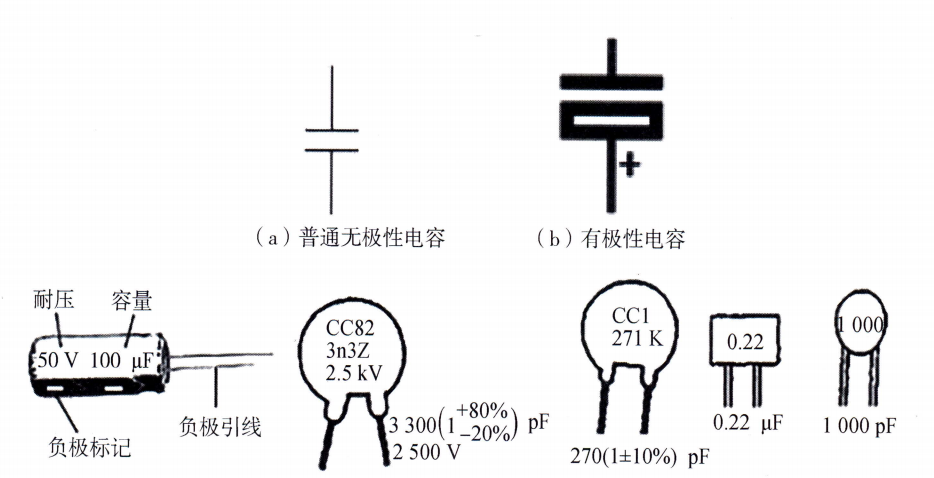
Figure 12-4 Symbols and Shapes of Capacitors
II. Measurement of capacitance (Pointer multimeter)
2. Estimation of microfarads (μF) capacitance capacity
Can be used empirically or with reference to a standard capacitor of the same capacity, according to the pointer swing of themaximum extentTo determine. The referenced standard capacitors do not have to have the same withstand voltage value, as long as the capacity is the same.
Example:To estimate a 100 μF/250 V capacitor, use a 100 μF/25 V capacitor as a reference, as long as the maximum amplitude of their pointer swings are the same, it can be concluded that the capacity is the same.
3. Estimated capacitance in picofarads (pF)
require the use of R×10kΩ The capacitance of a capacitor can only be measured above 1000 pF.
Judgment Criteria:For 1000 pF or slightly larger capacitors, a slight swing of the meter needle is considered sufficient capacity.
Before measuring the capacitance, be sure to perform aDischarge processing(especially high-voltage large-capacity capacitors) to avoid damage to the multimeter or the risk of electric shock. Measurement with a pointer multimeter utilizes the charging and discharging characteristics of the battery inside the meter on the capacitor.












 Chinese
  English
  Korean
  Japanese
  Thai
Thai  Arabic
  Spanish
  Russian
  Vietnamese
  Indonesian

