

Proper Use of Portable Megohmmeters to Measure Insulation Resistance Values of Electrical Equipment
I. Basic Concepts of Megohmmeter
Uses:Megohmmeter is a special instrument used to test the insulation resistance of electrical equipment or power lines.
Ingredients:The hand-cranked megohmmeter consists of a ratio-type magneto-electric system measuring mechanism and a hand-cranked generator.
1. Ratio-type magneto-electric system measurement mechanism:It is characterized by two coils generating opposite moments, an uneven magnetic field, and a guide wire that does not act as a reaction spring.
2. Hand-cranked generators:There are two kinds of alternators: DC generators and alternators, which send out alternating current and rectify it into direct current. According to the different voltages issued by the generator or rectified, megohmmeter has: 100 V, 250 V, 500 V, 1000 V, 2500 V and other types, of which the commonly used are 500 V, 1000 V.
3. Principles of operation
Megohmmeter simplified schematic diagram shown in Figure 13-20, coil 1 is called the voltage coil, coil 2 is called the current coil. When the EL open-circuit, shaking the generator, coil 1 current $I_u$, under the action of the magnetic field to produce torque, driving the needle counterclockwise rotation, although the hairspring does not react to the role of the spring, but due to the magnetic field is not uniform, the meter needle is pointed at the “∞” no longer go forward. When EL is short-circuited, coil 1, 2 have current, produce the opposite moment, but as long as the meter needle is not in the zero position, coil 2 moment is greater than the moment of coil 1, the meter needle rotates clockwise, due to the magnetic field is not uniform, the meter needle stops in the zero position and no longer go forward. When there is a resistor connected between EL, the position of the meter needle is related to the size of the resistor, the resistance value of the meter needle to the left, the resistance value of the meter needle to the right, so we can measure the size of the measured resistance according to the position of the meter needle, that is, the size of the measured insulation resistance.
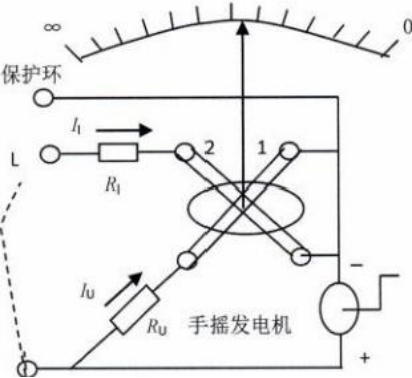
Figure 13-20 Simplified Schematic of Megohmmeter
In the measurement of insulation resistance between the metal armored cable core and metal armor, if the surface of the insulation layer is not clean, there will be a surface leakage current flows through, affecting the measurement results, if a metal ring will be surrounded by a wire, and then connected to a protective ring, as shown in Figure 13-21, so that the surface leakage current flows directly back to the generator's negative pole through the protective ring, so that there is no effect on the results of the measurement.Metal armor to E, insulation to protective ring.
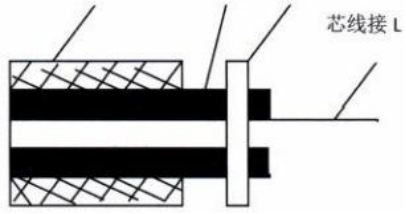
Figure 13-21 Wiring the MΩ meter when measuring cable insulation
II. Measurement steps and precautions
- ● Equipment up to 500 V: Apply a 500 V megohmmeter.
- ● Equipment above 500 V and below 1000 V: Apply a 1000 V megohmmeter.
- ● Equipment above 1000 V: a 2500 V megohmmeter should be used.
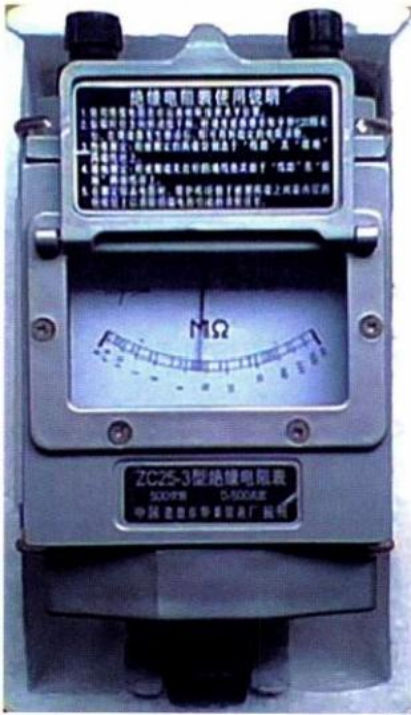
Figure 13-22 Hand-operated Megohmmeter
1. Operational steps
(1) Insulation of motor windings to ground:E connects to the case, L connects to the winding outlet. The speed gradually reaches 120r/min (or press and hold the power button) for about 1min, and the value after the needle is stabilized is the insulation resistance value (unit: MΩ). When measuring the in-use motor on board, the L terminal is usually connected to the thermal relay in the control box, and the E terminal is connected to the box without opening the motor junction box. If the resistance value is very small, you should remove the wires and measure the motor separately to determine whether the wires are poorly insulated to ground.
(2) Insulation between motor windings:The junction box connection piece must be removed and measured between UV, UW and VW respectively. General 0.5 MΩ or more can be used. The new motor should be 5 MΩ in cold state and more than 2 MΩ in hot state. Semi-hermetic refrigeration compressor motor should be more than 10 MΩ can be used.
(3) Transformer winding to core:E is connected to the iron core and L is connected to the primary and secondary windings respectively.
(4) Between transformer windings:E and L are connected to two windings. Multi-winding transformers need to be measured several times separately.
(5) Electrical wiring:Disconnect all loads before measuring.
2. Precautions for use
(1) Safety disconnect:Disconnect the power supply and discharge the capacitor-containing equipment before measurement. Also discharge after measurement.
(2) Instrument self-test:Open-circuit shaking pointer should point to ∞; short-circuit slow shaking (not fast shaking) pointer should point to zero. Meet this condition indicates that the instrument is good.
(3) Wiring Specifications:L to core (winding), E to ground (chassis).
(4) Environmental requirements:The hand-operated megohmmeter should be placed flat and away from strong magnetic fields.
(5) Shaking norms:The reading is taken at a slow to fast speed, gradually reaching approximately 120 r/min for approximately 1 min.
(6) Fuse requirements:Do not use stranded or double stranded wire for lead wires.
(7) Electronic equipment protection:Do not measure electronic circuit boards directly. If the equipment contains semiconductor devices, isolate them or temporarily short them with wires before measuring.











 Chinese
  English
  Korean
  Japanese
  Thai
Thai  Arabic
  Spanish
  Russian
  Vietnamese
  Indonesian

