
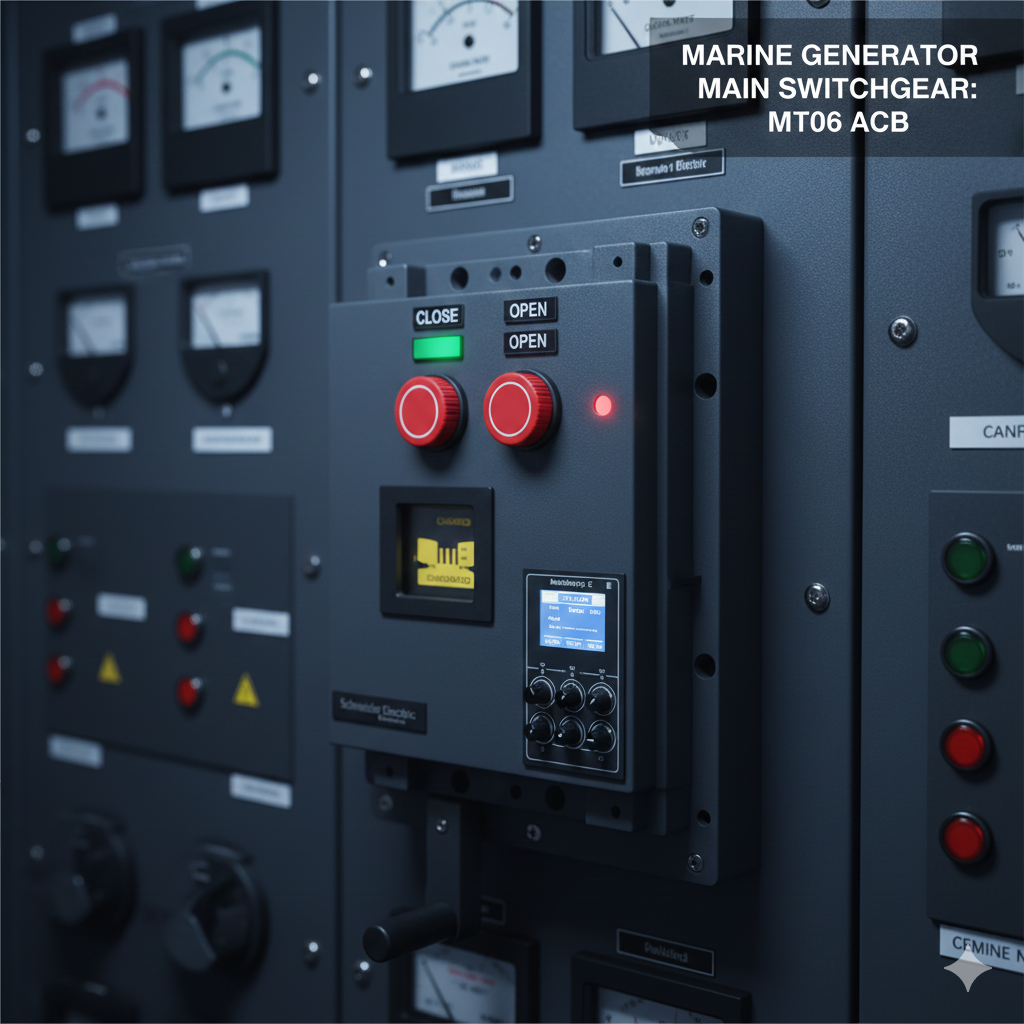
Ship generator main switch (ACB) full analysis: structure, principle and practical operation
In a marine power station, the generator main switch (air circuit breaker, abbreviated as ACB) is the key hub connecting the generator and the busbar. It is not only responsible for daily closing and closing operations, but also integrates complex protection functions.
I. Core body identification: three main disconnectors
The striker is the “executive organ” of the main switch, and according to the original text, the following three types of protection elements are recognized:
-
Under-voltage Release
-
Role: Voltage below rated value 40% Forced trip; voltage above 75% Only then can the gate be closed.
-
Rectification: 35%~70% Rated voltage.
-
-
Over-current Trip
-
Role: Provides short circuit protection and overload protection.
-
-
Shunt Release
-
Role: Receive remote electrical signals to realize “remote switching”.
-
Second, the closing mode details: manual and electric
The core premise of closing a gate is **“store energy first, then act ”**.
1. Motorized closing mode
-
Motor energy storage: After the switch is opened, the built-in motor automatically compresses the spring for the next action.
-
The closing solenoid stores energy: When the button is pressed, the coil is energized to complete the whole process of “energy storage - debuckling and then debuckling - releasing”, which takes only about 0.1s.
2. Manual closing method
-
For manual energy storage switches (e.g. Schneider MT or DW95), the operator needs toRepeatedly press the handle(manual energy storage) until the energy storage indicator shows “Charged” or “Energy stored”, then press the mechanical close button.
III. Practical assessment: key points of closing and closing operation
Candidates need to focus on the following processes according to the requirements of the original experimental set-up operation:
1. Closing logic
-
Standalone: Check energy storage indication $\rightarrow$ Confirm that the loss-of-voltage detent is energized (armature engaged) $\rightarrow$ Press to close the gate.
-
Parallelism: Open the synchronization table $\rightarrow$ Waiting for synchronization point (12 o'clock) $\rightarrow$ Press the closing gate quickly.
2. Breakout logic
-
Standalone: It must be followed.“Remove the load first, then open the gate”Principles.
-
Parallelism: It must be followed.“loadshifting $\rightarrow$ The solution condition is satisfied $\rightarrow$ sluice gate”Process.









 Chinese
  English
  Korean
  Japanese
  Thai
Thai  Arabic
  Spanish
  Russian
  Vietnamese
  Indonesian

