

Daily management and operation of marine batteries
I. Identification of the state of the battery and the use of related tools
Protection requirements:Ventilate the battery room before carrying out battery maintenance, wear personal protective equipment, goggles and rubber gloves as required.
1. Measurement of battery voltage and electrolyte relative density
When measuring the battery voltage and electrolyte relative density, the battery should be in a stable state. After charging, discharging or filling with distilled water, the battery should be left for half an hour before measurement.
(1) Multimeter measurement:Measure the voltage of individual cells of the battery with a multimeter DC voltage 10 V DC block. Check the positive and negative terminals of each cell, then connect the red pen to the positive terminal and the black pen to the negative terminal, and measure the voltage of each cell one by one.
(2) Densitometer measurements:A densitometer is used to measure the relative density of individual battery electrolytes as shown in Figure 9-1.
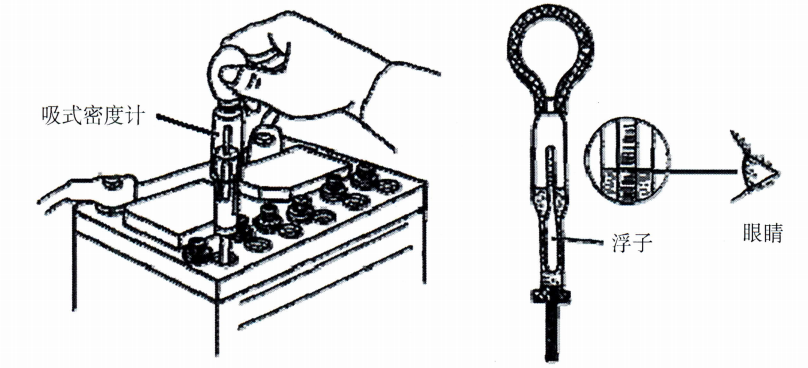
Figure 9-1 Measuring the Relative Density of the Electrolyte
(3) Criteria for status determination:
- A. The relative density of the electrolyte increases to 1.275-1.310.
- B. Individual cell voltage variations:
- a. The voltage rises to 2.1V upon initial charging.
- b. Slowly increase the voltage to 2.3V.
- c. Charge for a few more hours to about 2.6V and keep it there.
- A. The relative density of the electrolyte decreased to 1.13-1.18.
- B. Individual cell voltage variations:
- a. The voltage drops to 2.00~1.95V when just discharged.
- b. Voltage slowly decreases to 1.9V.
- c. Quickly drops to 1.8~1.7V, indicating that the battery is discharged.
2. Preparation and adjustment of acid battery electrolyte (1.35-1.40)
(1) Preparation:Protective eyewear, rubber gloves, glass rod, beaker and densitometer, multimeter, etc.
(2) Raw materials:Concentrated sulfuric acid with a relative density of 1.835 to 1.840 should be used.
(3) Core protocol: Concentrated sulfuric acid should be poured slowly into distilled water and stirred constantly with a glass rod, and distilled water should not be poured into concentrated sulfuric acid to avoid the solution from generating high temperatures locally and splashing injuries.
(4) Results:Measure the density of the electrolyte with a densitometer to see if it reaches 1.35~1.40 g/cm³.
II. Charging and discharging operation of the battery
(1) Charging methods are mainly:
① Constant voltage charging method; ② Constant current charging method; ③ Segmented constant current method; ④ Float charging method (the battery is directly connected in parallel with the DC grid).
(2) Charging and overcharging of lead-acid batteries by segmented constant-current method
② Connect the battery connector to the charger and the input cable to the 220 V plug, and finally turn on the charger switch.
③ Phase I:The current is set at 1/10 of the rated capacity value, the charge is about 10h, and the monomer rises to 2.4V when it is transferred to the second stage.
④ Phase II:Adjust the current at 1/20 rated capacity, charge for 3~5h, adjust the density to 1.285g/cm³.
⑤ Charge at the second stage current for 1h, and the charging is finished.
⑥ Overcharge:After the end of normal charging stop 1h, change to half the normal rate of current charging, to the bubble after stopping 1h recharging, repeated 2~3 times, until the voltage and density does not change.
(3) Recording and monitoring:When discharging the battery, record the discharge voltage, discharge current, etc. at the beginning and end of discharge. When charging, check the status of the charger and record the charging voltage and current.
Figure 9-2 shows the charger/discharger board. The upper switch selects No.1 or No.2 charger; the lower switch selects No.1 discharge/No.2 charge, dual group float charge, No.2 discharge/No.1 charge. The lower part is equipped with a 24V ground test button, a ground indicator and a 24V power supply switch.
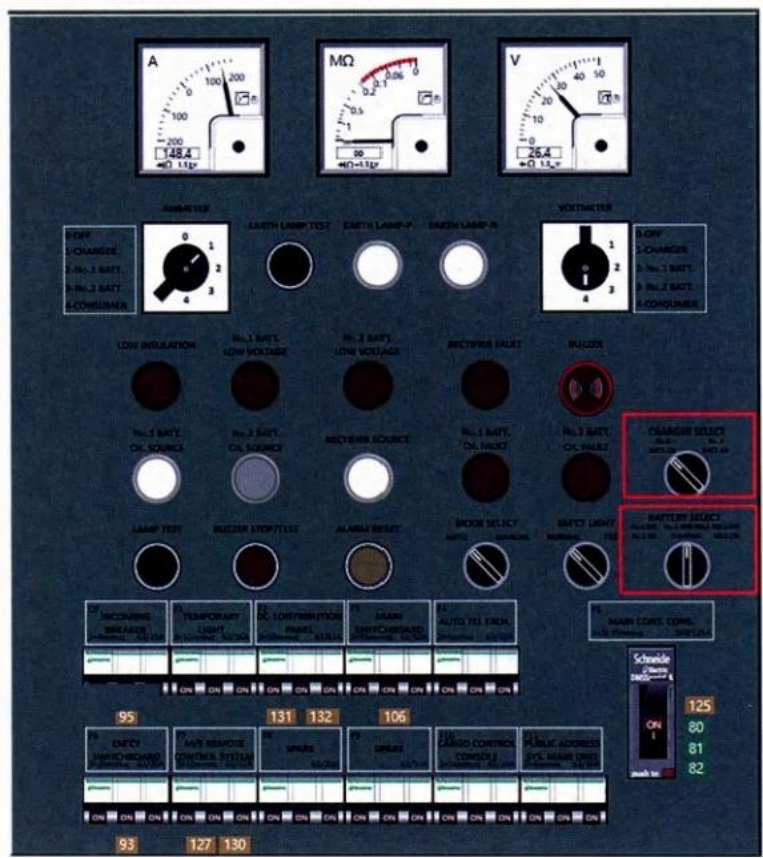
Figure 9-2 Charge and Discharge Board
III. Maintenance requirements for acid batteries
- Chowder:
Check and record the voltage, height and density every seven days or so. The liquid level should be 10~20mm above the pole plate. - Monthly:
Batteries that are used infrequently should be inspected at least once a month and discharged with a load and then recharged. - Quarter:
Thoroughly clean the surface every three months, wipe off the oxides with a dry cloth and apply theButter or VaselinePrevents oxidation.












 Chinese
  English
  Korean
  Japanese
  Thai
Thai  Arabic
  Spanish
  Russian
  Vietnamese
  Indonesian

