

UPS Uninterruptible Power Supply Systems: A Practical Guide to Setup, Operation and Maintenance
Section I. UPS Overview
UPS is the English abbreviation for Uninterruptible Power System. When power quality problems occur in the power grid, such as surge, high voltage spike, transient overvoltage, voltage sag, line noise, frequency shift, continuous low voltage, power supply interruption, the UPS will ensure the output of stable, pure, uninterrupted sinusoidal AC voltage so that the microcomputer system or the corresponding control system can continue to maintain normal operation.
Core conversion logic:UPS in the usual sense of the input is 220V AC, the output is also 220V AC, but through the middle of the power electronic conversion and battery link. In the 220 V normal power supply, through the rectifier to keep the battery charged, while the inverter can output 220 V AC; in the power supply 220 V power failure, the battery through the discharge and inverter, can continue to maintain a period of 220 V output to achieve uninterrupted power supply.
Alarm Mechanism: Audible and visual alarm when battery energy is about to be exhausted. When overloaded (150% load), jumps to bypass state and returns automatically when load is normal.
UPS Three major classifications
Core Component Composition
For use with loads or inverters and as a charger to power batteries.
Capacity determines the time to maintain discharge. Converts chemical and electrical energy to each other.
It consists of an inverter bridge, control logic and filter circuit.
It consists of SCRs and is divided into conversion type (dual power supply switching) and parallel type.
Section 2: Use and Maintenance of UPS
I. UPS startup and shutdown sequence
1. First power-up:Storage battery switch → automatic bypass switch → output switch “ON”. Press the “ON” button to start, wait until the “Bypass” lamp goes out and turn to inverter power supply. After 10min of no load, turn on the load from small to large.
2. Daily start-up:Press the “ON” button and turn on the load switch after about 20 min of stabilization (the manual maintenance switch should be “OFF”).
3. Shutdown:Turn off the load first, let the UPS run no-load for 10min to remove heat, and then press the “Off” button on the panel.
Precautions for the use of UPS
- Environment: Avoid dust and grease intrusion.
- Sequence: power on (power supply → UPS → load); power off (load → UPS → power supply).
- Contacts: Ensure that air switches, gate knives, sockets, etc. are making good contact and are not firing.
- Load limitation: It is not allowed to connect inductive loads (such as electric drill), and overloading is prohibited.
- Heat dissipation: Clean air inlet holes every 2-3 months.
III. Routine maintenance and overhaul (battery focus)
The main work lies in dust control and battery maintenance. Quarterly thorough cleaning of the mainframe is required. Maintenance still requires in-depth analysis as the UPS fault self-test may have false alarms.
Section III UPS Setup and Maintenance Example
I. UPS operation mode status check
APC UPS Panel Legend Explanation
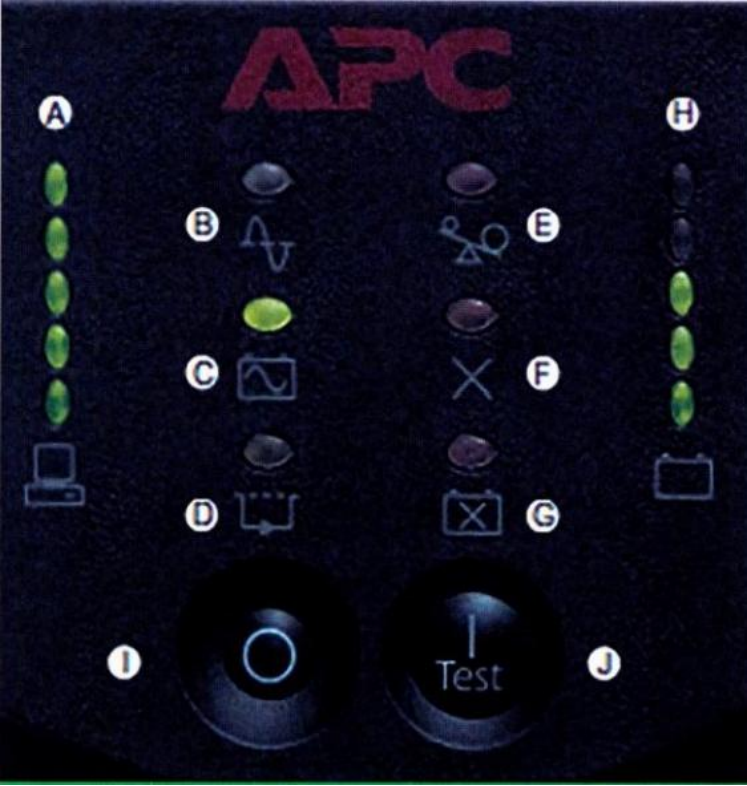
Figure 10-1 APCUPS Panel
UPS operation mode switching test practice
Test Process SOP:
- Shut down all critical loads.
- Disconnect the boat power input switch (analog loss of power).
- Start the UPS with the battery, switch toBattery powered modeCheck the inverter voltage and light display.
- Close the boat power input switch and verify that the UPS can automatically jump back to thenormal mode(ship's electric power supply).
- If the jump is abnormal, disconnect the mains switch again after a few seconds to observe the inverter status.







 Chinese
 English
 Korean
 Japanese
 Thai
Thai Arabic
 Spanish
 Russian
 Vietnamese
 Indonesian

