
管型、基极与集电极教程.jpg)
Basic electrician practice: identification and measurement of transistors
I. Basic Concepts of Transistors
A transistor is one of the most fundamental semiconductor devices in electronic circuits, capable of amplifying signals, switching control, and modulating signals. It is a core component of modern electronic devices, having replaced early vacuum tubes, and offers advantages such as small size, low power consumption, and high reliability.
Transistors are divided into two main categories:Bipolar Junction Transistor (BJT) 和Field-Effect Transistor (FET). A bipolar transistor consists of three layers of semiconductor material (NPN or PNP) and is classified intoEmitter (E)、Base (B) 和Collector (C)。
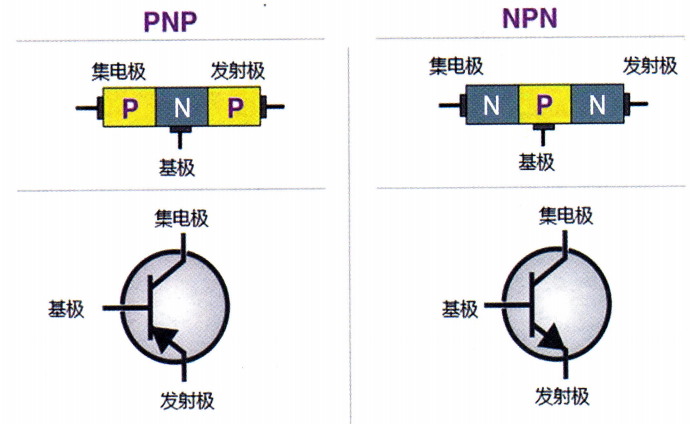
Figure 12-6 Symbol for a BJT
II. Practical Transistor Measurement (Analog Multimeter Method)
When identifying transistors, remember: “Three inversions—find the base; two correspondences—find the collector.” When using an analog multimeter, the black probe is connected to the positive terminal of the internal battery; this is crucial for determining whether a transistor is NPN or PNP.












 Chinese
  English
  Korean
  Japanese
  Thai
Thai  Arabic
  Spanish
  Russian
  Vietnamese
  Indonesian

