

Proper selection and use of grease for motor bearing oiling
Electric motors are ubiquitous in modern ship operations, and they are key components to ensure the safe and efficient operation of ships. As an indispensable component of electric motors, bearings undertake the important task of supporting the rotor and ensuring its stable rotation. The two main roles of bearings are to support the shaft and the parts on the shaft, to maintain the rotational accuracy of the shaft and to reduce the friction and wear of the rotor in the process of rotation.
I. Introduction to Bearings
(i) Basic knowledge of bearings
Rolling bearings support and guide machine parts with minimal friction and transfer loads between machine parts. They are usually divided into two categories:ball bearing(point contact) withroller bearing(line contact).
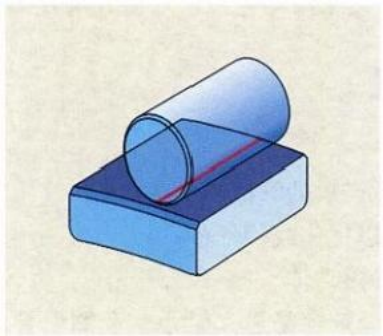 Figure 23-1 Line Contact Schematic
Typical rolling bearing assembly (e.g., Figure 23-2):
1. Bearing rings:Standard steel is 100Cr6. 2. Rolling body:Steel or ceramic. 3. Cage:Separate rolling bodies to reduce frictional heat. 4. Built-in seal:Prevent intrusion of contaminants. 5. Dust cover:Low friction applications. 6. Sealing:Moderate pollution conditions are preferred. 7. Swimming Gap:Radial or axial moveable distances to ensure running accuracy.
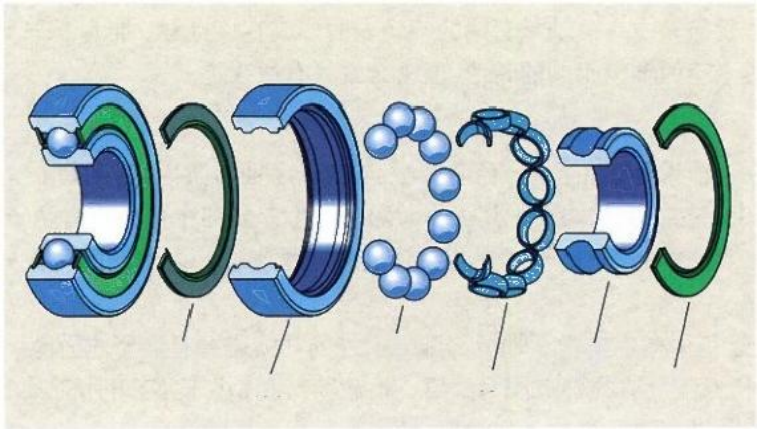 Figure 23-2 Rolling Bearing Assembly
Bearing code identification example: 6208-2Z/P6
- “6”: deep groove ball bearings; “2”: size series; “08”: inner diameter of 40mm;
- “2Z”: both end faces with dust cover; “P6”: tolerance class 6.
(ii) The impact of bearings on motor performance and the importance of maintenance
Bearing quality is directly related to vibration control and noise management. Approximately 36% Bearing failure is caused by poor lubrication. Correctly added lubricant reduces friction, carries away heat, and prevents corrosion.
Table 23-1 Regular Manufacturer's Bearing Agreed Life Reference (Partial Display)
| Machine type | Approximate life/h |
|---|---|
| Industrial motors, rotary crushers | 10000~25000 |
| Medium-sized motors and pumps for 24h continuous operation | 40000~50000 |
| Spindles and large electric motors for ocean-going vessels | 100000~200000 |
II. Introduction of lubricating grease
(i) Role, classification and key parameters
Lubricating grease consists of base oil (>70%), thickener and additives. Ship's nacelle motors are mostly usedLithium grease(Good mechanical stability and high temperature performance).
(iii) Butter guns and nozzles
A special grease gun (grease gun) is required for adding lubricating grease. The structure contains grease reservoir, piston rod, pump core valve system and grease outlet.
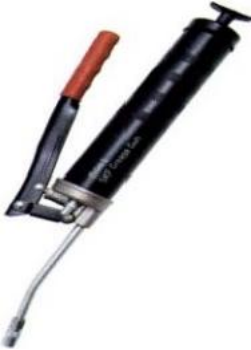 Figure 23-3 Butter Gun
Buttermilk nozzle shape (as in Figure 23-4): (1) Straight nozzle (2) Curved nozzle (3) T-shaped nozzle. Sizes are divided into metric (M6~M20) and imperial (pt1/8~pt1/2).
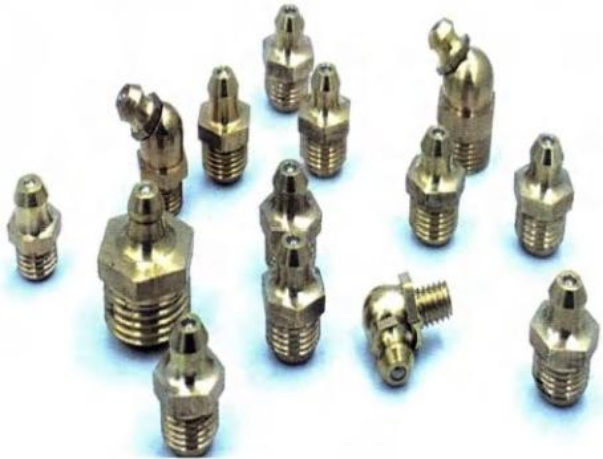 Figure 23-4 Butter Nozzle
(iv) Refueling operations and norms
1. Fueling practices
- ● Mixing is strictly prohibited:Prevent mixing of different ingredients from causing dilution, sloughing or failure.
- ● Select by load:For heavy loads, select high viscosity base oils or greases with extreme pressure additives (molybdenum disulfide).
- ● Select by speed:High-speed parts should be selected from grease with high consistency and good adsorption.
- ● Quality Identification:Good quality grease is a homogeneous thick paste with no odor. Lithium-based grease is usually difficult to ignite.
2. Correct filling procedure
- Clear the exhaust:Clean the butter gun and gently push the handle to expel air after loading.
- Observe the grease outlet:Ensure that the outflow is continuous, uniform and free of air bubbles.
- Clean the oil fill port:Wipe the motor oiling port with a clean cloth.
- Control the amount of refill:Usually the clearance of the bearing chamber 1/3 to 1/2。
- Operational monitoring:After adding and running for 10min, monitor the temperature, sound and current.
⚠️ Note: Clean up old tallow regularly; run for a short time after filling to ensure even distribution; if there is no pressure on the fill, check for damage to the piping or membrane.



 Chinese
  English
  Korean
  Japanese
  Thai
Thai  Arabic
  Spanish
  Russian
  Vietnamese
  Indonesian

