

Structure Identification and Disassembly/Assembly Practices for Asynchronous Motors
I. Asynchronous motor structure identification
The three-phase asynchronous motor is a much used electrical equipment on board. It is a device that utilizes the principle of electromagnetic induction to convert electrical energy into mechanical energy.
Three-phase asynchronous motor consists of two main parts: stator and rotor. The stator includes: shell, stator core, stator winding, end cover and so on. The rotor includes: rotor core, rotor winding, shaft and so on. Rotor winding can be divided into two types of squirrel cage and wirewound. Enclosed three-phase squirrel cage asynchronous motor structure shown in Figure 16-5.
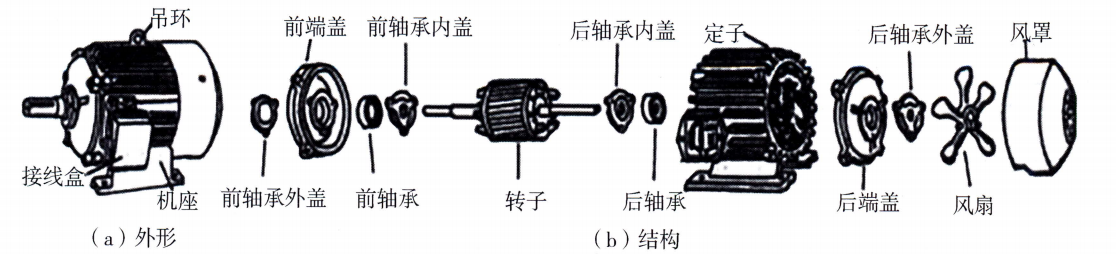 Figure 16-5 Structure of enclosed three-phase squirrel-cage asynchronous motor
(i) Stator section
1. Shell:It is used to protect and fix the stator winding of three-phase asynchronous motor, and its appearance is cast with heat sink to increase the heat dissipation area.
2. Stator core:It is made of thin silicon steel sheets laminated together. Since the silicon steel sheets are coated with insulating varnish between each other and the silicon steel sheets are thin, the core eddy current loss caused by the passage of alternating magnetic flux can be reduced, as shown in Figure 16-6.
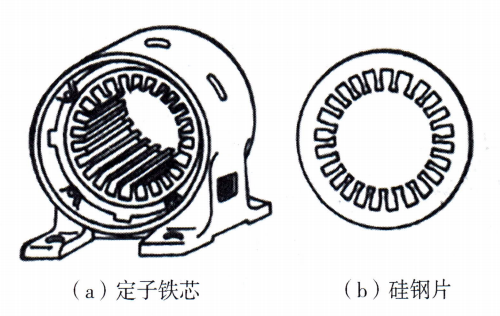 Figure 16-6 Schematic of Stator Core and Silicon Steel Sheet
3. Stator windings:Each winding is a phase, and each winding differs in space by an electrical angle of 120°.
4. End caps:The end caps hold the rotor in the center of the stator cavity, allowing the rotor to rotate evenly in the stator.
(ii) Rotor section
1. Rotor core:The rotor core is used to house the rotor windings as part of the motor's magnetic circuit.
2. Rotor windings:There are two types: wire-wound and squirrel-cage.
- ● Wire-wound windings:Generally connected to a Y-shape, the operating characteristics of the motor are usually improved by stringing resistors in the rotor circuit, as shown in Figure 16-7.
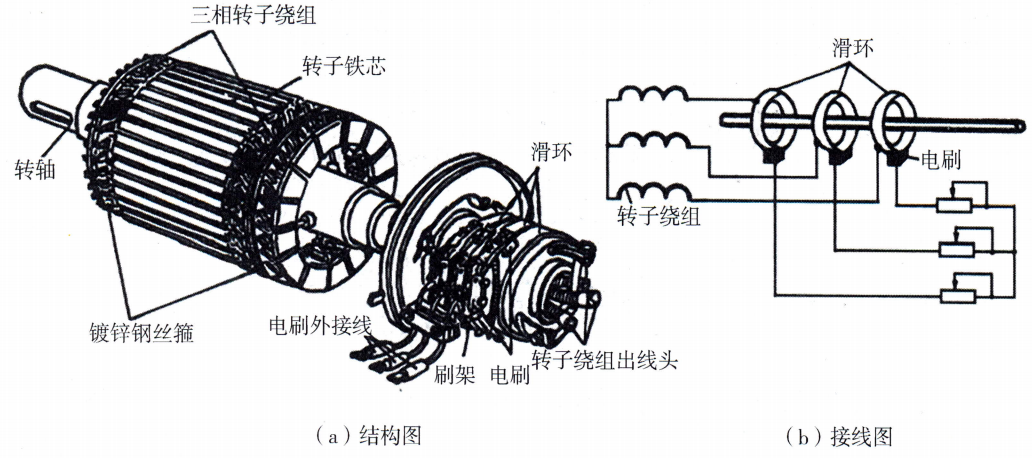 Figure 16-7 Wire-wound winding
 - ● Squirrel-cage windings:In order to improve the starting performance, the squirrel cage rotor generally adopts the slant slot structure, as shown in Figure 16-8.
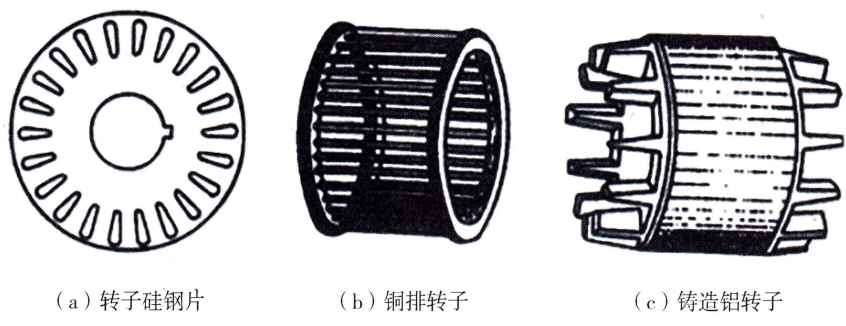 Figure 16-8 Squirrel-cage winding
II. Asynchronous motor disassembly
(i) Motor disassembly steps
When it is necessary to inspect and treat the motor windings, inspect, replace or oil the bearings, treat the motor insulation, and clean the inside of the motor, it is necessary to disassemble (disassemble) the motor. The steps are:
(2) Remove the foot screws (if the coupling is belt-driven or screw-connected, remove the belt or connecting screws).
(3) Move the motor to a spacious, clean, and bright place, and take care of the related devices.
(4) Pull down the coupling or pulley with a puller and remove the air cover and fan.
(5) Mark between the end cap and the housing and remove the front bearing cover (if any) and the front end cap (coupling end). When disassembling, if there is a top wire hole, screws should be used to symmetrically top out the end cover; if there is no top wire hole, a brass rod or wood can be used to gently and symmetrically beat down the end cover. Do not hit with hard metal to avoid damage to the end cap.
(6) Remove the rear end cover screws and take out the rotor (lift it out with both hands, do not scratch the stator windings).
(7) To replace the bearings, remove the rear end caps and pull down the front and rear bearings with a puller.
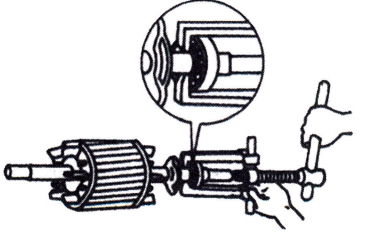 Figure 16-9 Bearing Disassembly
Bearing disassembly precautions:
- (1) Specialized pulling tools - pulling horses - are required.
- (2) Align the screw with the center hole of the shaft.
- (3) The tensile force shall be applied to the inner ring of the bearing.
- (4) The tip of the pulling horse must not damage the center hole of the rotor shaft end.
(ii) Motor assembly steps
The assembly step is in principle the opposite of the disassembly step, i.e., what is disassembled later is assembled first.
1. Bearing mounting
Bearings that are checked and deemed ready for further use should be installed back on the shaft. The journal should be checked before installation, the journal must be smooth and clean, without rust, cracks, burrs, pockmarks and other scars, if there is a slight corrosion, can be used to lighten gently with fine gauze. Commonly used installation methods include the punch-in method and the hot set method.
(1) The punch-in method:Stand the rotor upright and place a cork board underneath it, smear a layer of oil on the journal, put the bearing on, put a suitable metal tube against the inner ring of the bearing, and gently tap the tube with a hammer until the bearing reaches the specified position. If a suitable metal tube is not available, a copper rod can be used against the inner ring of the bearing and tapped evenly along the circumference of the inner ring to bring it into place, as shown in Figure 16-10.
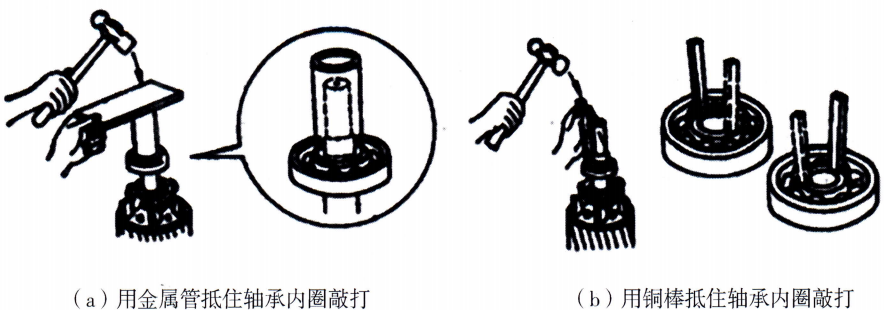 Figure 16-10 Bearing Mounting
(2) Heat-set method:The bearings are fitted by placing them in hot oil and heating them to about 100°C, then placing them on the journals and immediately tapping them gently with a suitable pipe.
Grease filling specification:After installing the bearings, grease the bearings:
● High speed (1500 r/min or more): Add about 1/2 of the bearing space.
● Low to medium speed (1500 r/min and below): Add about 2/3 of the bearing space.
※ Do not fill it up to avoid affecting heat dissipation.
2. Installation of electric motors
The installation process for electric motors is the opposite of the dismantling process, i.e., what is removed first is installed later.
① Install the bearing on the rotor; ② Install the rear end cover on the rotor; ③ Install the rotor and tighten the rear end cover screws initially; ④ Install the front end cover; ⑤ Coil the rotor; ⑥ Tighten the screws; ⑦ Install the wind blades and wind cover; ⑧ Install the coupling.
① The coupling must be correctly aligned, not twisted, and the cushion must be indispensable.
② Reliable electrical connection should be made between the motor and the hull, and insulating materials should not be used as gaskets.
③ Fixing screws should be tightened and rotated flexibly.
④ Perform steering, no-load, and load tests.
(3) Assembly Precautions
① Do not make a mistake in assembling the product according to the markings made at the time of disassembly. ② Do not leave foreign objects inside. ③ Use the correct tools and screws. Tighten the screws symmetrically to protect the stops and maintain concentricity. ⑤ Do not damage the winding. ⑥ Do not use hard metal such as hammer to strike the bearing, and soft metal pads are required to strike the end cap. The direction of the front and rear end caps should not be mistaken. Tighten the screws according to the symmetrical direction successively. (vii) Check the flexibility of rotation by coiling, and find out the reasons for the missing parts.












 Chinese
  English
  Korean
  Japanese
  Thai
Thai  Arabic
  Spanish
  Russian
  Vietnamese
  Indonesian

